
Folio Society Published Works Number 2271
Roland - The Song of Roland
We buy and sell items like these, so please contact us if you have similar items for sale, and we will make you an offer if we are interested.
To check if we have this item, or similar items, in stock, please click the Check Stock link below. Alternatively, use the links on the left to search our large online database of items for sale, or to visit the rest of the site.
Check Stock
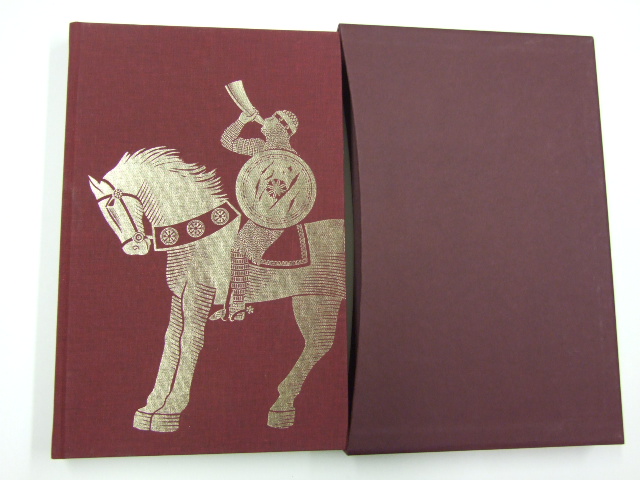
Roland - The Song of Roland (Published in by The Folio Society in 2010. The Song of Roland. Introduced by John Burnside. Illustrated by Anna and Elena Balbusso. In 778, the rearguard of Charlemagne's retreating army was ambushed in the Pyrenees and defeated. The battle of Roncevaux became the inspiration for songs and poems celebrating deeds of valour in the face of overwhelming odds. In the mid 12th century, part of this great retelling of heroic deeds was The Song of Roland. Blocked with a design by Anna and Elena Balbusso. Translated by Charles Scott Moncrieff. Bound in cloth. Set in Centaur. 176 pages. Frontispiece and 8 colour illustrations. Book size: 11" x 7.25". The Song of Roland. 'For who will lead my armies with such strength,. When he is slain, that all our days us led?. Ah! France the Douce, now art thou deserted!. Such grief I have that I would fain be dead.'. In 778, the rearguard of Charlemagne's retreating army was ambushed in the Pyrenees and defeated. The battle of Roncevaux became the inspiration for songs and poems celebrating deeds of valour in the face of overwhelming odds. In the mid 12th century, part of this great retelling of heroic deeds was The Song of Roland, the earliest surviving work of Old French and one which shows a chivalric, knightly society in full flower. It is a celebration of heroism, of feudalism and of the Franks and their love of 'France the Douce'.. Roland, most valiant of knights, is in command when the Saracens attack, directed by the traitor Ganelon. Although Roland's friend Oliver begs him to blow his olifant and recall the main part of the army, Roland refuses. A small force of Franks makes a last stand against 400,000 Saracens, and, one by one, the brave warriors fight to the death. At last, Roland blows the horn and Charlemagne gallops to the rescue – but the king is too late to save his valiant paladins, and can only avenge their deaths.. Charles Scott Moncrieff fought during the First World War, and translated the Song of Roland during the summer of 1918, when 'the sound of the olifant came so often and so direfully across the Channel'. His courtly and romantic translation, written in the original measure, is dedicated to his three best friends, including the poet Wilfred Owen, who died in the war. With its focus on honour and the feudal obligations between lord and vassal, the poem is a rich evocation of a vanished age. Yet its depiction of its soldiers, their trust in one another, their capacity for heroism and their grief for their fallen comrades, resounds through the centuries. This Folio Society edition contains exquisite illustrations by sisters Anna and Elena Balbusso. Poet John Burnside contributes a sensitive introduction exploring the chivalric code of the poem and the paradoxical nature of Roland's sacrifice.. 'In their emotional range, in their recognition of terror and, most of all, in their profound grief for their doomed companions, these men are much more heroic, and much more true to life, than their fictional counterparts of more recent times'. JOHN BURNSIDE. )