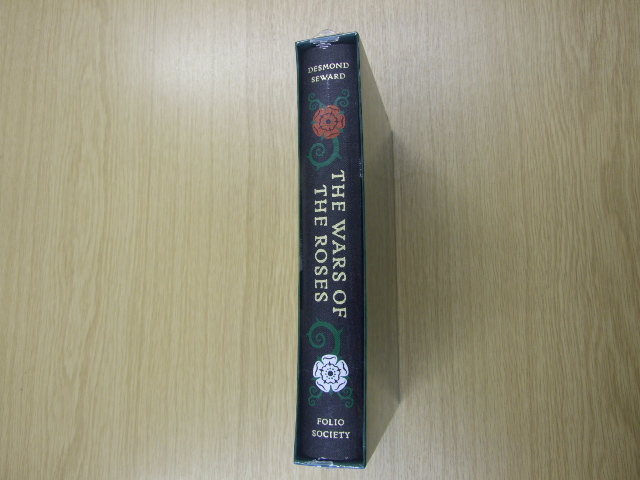

Folio Society Published Works Number 2415
Seward, Desmond - The Wars of the Roses
We buy and sell items like these, so please contact us if you have similar items for sale, and we will make you an offer if we are interested.
To check if we have this item, or similar items, in stock, please click the Check Stock link below. Alternatively, use the links on the left to search our large online database of items for sale, or to visit the rest of the site.
Check Stock
Seward, Desmond - The Wars of the Roses (Published in by The Folio Society in 2011. New preface by the author. Bound in buckram. Blocked with an illustration by Frances Button. Set in Janson. 400 pages. Frontispiece and 24 pages of colour and black & white plates. Book Size: 10 × 6.75 ins. 'The getting of the garland, keeping it, losing and winning again, it hath cost more English blood than hath twice the winning of France.' So said the Duke of Buckingham in 1483 of the prolonged and bloody conflict between the Houses of York and Lancaster, which later became known as the Wars of the Roses. Between 1455 and 1487, it claimed the lives of three kings, a Prince of Wales, eight dukes and a third of the peerage, as well as thousands of knights and ordinary soldiers. Desmond Seward's scholarly and engrossing work conveys all the drama of those turbulent decades. While most histories focus on the rival kings – Henry VI and Edward IV, Richard III and Henry VII – Seward builds his account around five individuals from both sides, whose eventful careers spanned the Wars. They are the Yorkist hero William Hastings, noted for his bravery, personal charm and dissolute private life; the Lancastrian John de Vere, a fine soldier and tactician; Lady Margaret Beaufort, who founded the Tudor dynasty when she gave birth to the future Henry VII at the age of 13; Dr John Morton, who was taken prisoner by the Yorkists after the battle of Tewkesbury and joined their cause; and Jane Shore, the mistress of Edward IV, forced to do public penance by walking barefoot through the City of London. Seward uses these five figures to guide us skilfully through the plots, beheadings, dynastic marriages, murders and exiles of these terrible decades. The English were regarded as the most bloodthirsty race in Christendom; the French chronicler Froissart wrote, 'They take delight in battles and slaughters.' Europe watched with amazement as entire noble families were exterminated and their property confiscated. Switching allegiance inevitably became a habit among the ruling class, not out of disloyalty but out of sheer terror. Seward shows how, because of the fragility of the regimes, these difficult choices had to be made again and again. This is an outstanding account, both vivid and intimate, of one of the bloodiest periods in English history. )