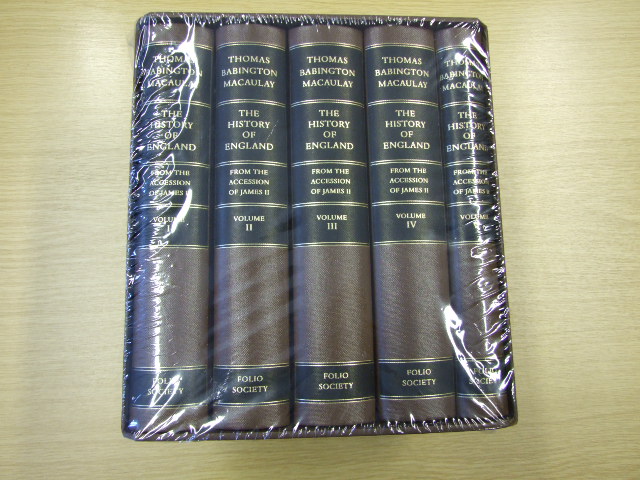

Folio Society Published Works Number 2417
Macaulay, Thomas Babington - The History of England from the Accession of James II Introduction by Peter Rowland in 5 Volumes
We buy and sell items like these, so please contact us if you have similar items for sale, and we will make you an offer if we are interested.
To check if we have this item, or similar items, in stock, please click the Check Stock link below. Alternatively, use the links on the left to search our large online database of items for sale, or to visit the rest of the site.
Check Stock
Macaulay, Thomas Babington - The History of England from the Accession of James II Introduction by Peter Rowland in 5 Volumes (Published in by The Folio Society in 2009. Five volumes. Bound in a classic buckram binding, relief-blocked with coins from the late 17th and early 18th centuries. Set in Baskerville. 2,696 pages with 72 pages of colour and black & white illustrations. Newly commissioned introduction from Richard J. Evans, Regius Professor of Modern History, University of Cambridge. Book Size: 10 x 6.25 ins. One of the greatest and most influential works of history. In the first half of the 19th century, Europe was convulsed by revolution: in France, Spain, Germany, Hungary and Italy, kings were deposed, governments rose and fell, blood was spilt. Britain, it seemed, was uniquely fortunate in having avoided such tumult. It took the brilliant politician and man of letters Thomas Babington Macaulay to ask: How was it that Britain remained peaceful, while, as he put it, 'the proudest capitals of Western Europe have streamed with civil blood'? For Macaulay, the answer was to be found more than 150 years before, in the short period of British history following the 'Glorious Revolution' of 1688, when the British Parliament ousted one king and chose another, without the country descending into civil war. Macaulay made his case in one of the most successful and brilliant histories ever written. Macaulay was one of the first writers to draw on contemporary news-sheets, tracts and ballads as source material for his history. He greatly admired the novels of Sir Walter Scott, and believed that historians should learn from the dramatic techniques of novelists. This outlook gave him the ability to enter into the spirit of the times and convey what it was actually like to live through them – a revolutionary approach which would captivate readers, while his shrewd grasp of politics gave added power to his account. For its scope, its drama and its conviction, Macaulay's history remains as exhilarating to read as it was when it was first published. )