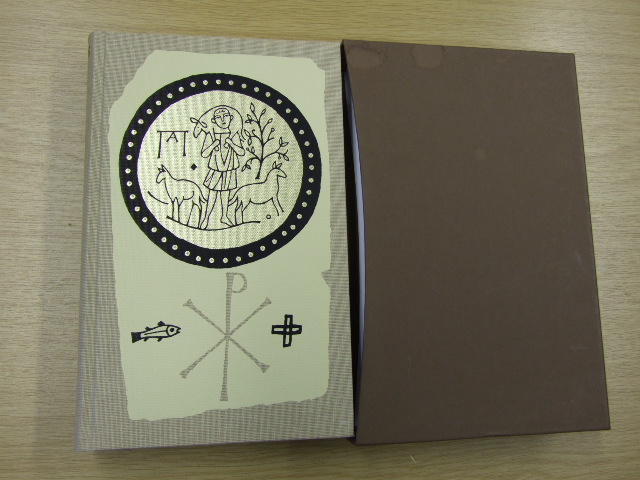

Folio Society Published Works Number 2459
Eusebius of Caesarea - The History of the Church from Christ to Constantine
We buy and sell items like these, so please contact us if you have similar items for sale, and we will make you an offer if we are interested.
To check if we have this item, or similar items, in stock, please click the Check Stock link below. Alternatively, use the links on the left to search our large online database of items for sale, or to visit the rest of the site.
Check Stock
Eusebius of Caesarea - The History of the Church from Christ to Constantine (Published in by The Folio Society in 2011. Preface by Dr Rowan Williams. Translated by G. A. Williamson. Bound in cloth. Blocked with an illustration by Joe McLaren. Set in Baskerville. Frontispiece and 24 pages of colour plates. Book size:10" × 6.25"; 448 pages. Sometimes termed the 'Christian Herodotus', Eusebius of Caesarea (c. 260–339) was the foremost historian of the ancient Christian world. He left behind the only surviving record of the Church during its crucial first three centuries, up to the sudden, seemingly miraculous conversion of Emperor Constantine. In writing his 'apology' for Christianity, Eusebius drew on many contemporary accounts that might otherwise have been lost. The founding text of Christian history, his account is a forerunner of works such as Bede's History of the English Church and People. Eusebius sought to demonstrate continuity between the apostles and the Christian authorities of his own times, showing how successive bishops had preserved the authentic religion. He chronicled the Church's struggle against heresy, and the sects whose members 'crawled like poisonous reptiles over Asia and Phrygia'. The history of the Church was, at this time, bound up with that of the Roman Empire, and Eusebius recorded the deeds of the successive emperors, merciful and cruel alike. He vividly depicted the hideous tortures inflicted on the early Christian martyrs during the Great Persecution at the beginning of the 4th century, some of which he witnessed with his own eyes: 'the most shameful, brutal and inhuman of all spectacles'. The ordeals of the Christians came to an end with the conversion of Constantine in 312, described by Eusebius in a tone of near ecstasy: 'Men had now lost all fear of their former oppressors; day after day they kept dazzling festival; light was everywhere, and men who once dared not look up greeted each other with smiling faces and shining eyes.' Eusebius portrayed Constantine as a divinely ordained leader and head of the Church, an idea that would, in the future, prove influential and controversial, for example during the English Reformation. This edition is introduced by Dr Rowan Williams, former Archbishop of Canterbury, who describes Eusebius as a major contributor to the ongoing debate within Christianity about the relation of the Church to political authority. )