
Folio Society Published Works Number 2647
Shelley, Mary - The Last Man
We buy and sell items like these, so please contact us if you have similar items for sale, and we will make you an offer if we are interested.
To check if we have this item, or similar items, in stock, please click the Check Stock link below. Alternatively, use the links on the left to search our large online database of items for sale, or to visit the rest of the site.
Check Stock
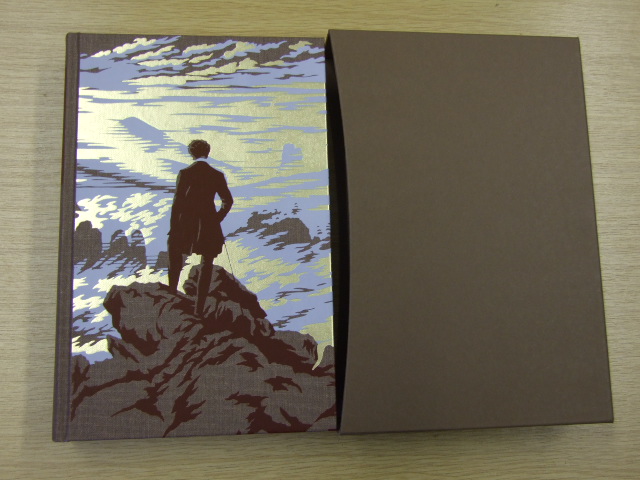
Shelley, Mary - The Last Man (Published in by The Folio Society in 2012. Introduced by Sarah Hall. Paintings by Caspar David Friedrich. Bound in cloth. Blocked with a design by Neil Gower. 440 pages. 13 colour paintings. Book size: 9.5" × 6.25". England, at the end of the 21st century, has become a republic. The last king has abdicated peacefully, and the egalitarian dream is close to realisation. But a plague is gathering in the East that will soon lay waste to human society. Written in 1822, The Last Man is a multi-stranded apocalyptic story about a mysterious disease that devastates humankind, leaving one lone survivor. Like Mary Shelley's first novel Frankenstein, it speaks to some of our deepest fears. As introducer Sarah Hall puts it, 'No noble arrangement, product of enlightenment or utopian dream is able to vanquish the foe'. Mary Shelley started writing The Last Man two years after the death of her husband Percy Bysshe Shelley. It is in part an elegy to the key figures of the Romantic circle, their hopes and ideals. Adrian, Earl of Windsor, the gentle and idealistic heir to the English throne who voluntarily gives up his royal status, was modelled on Shelley. Lord Byron appears as Lord Raymond, a charismatic aristocrat who is determined to seize power in England and conquer the world. The narrator, Lionel Verney, a shepherd from the Lake District and the 'last man' of the title, is modelled on the author herself. The novel chronicles their friendship, marriages and rivalry, before plunging them into a global crisis. The disaster is vividly evoked in terms that seem frighteningly real: refugees pouring into boats; London's streets deserted, or full of looting and pillaging. Monarchists, republicans, atheists and believers: all are helpless before the ever-spreading plague. This edition is illustrated with paintings by the German Romantic artist Caspar David Friedrich. Featuring lonely figures in stark but beautiful landscapes, they form a powerful counterpart to the text. Sarah Hall is herself the author of an award-winning dystopian novel, The Carhullan Army. In her introduction, she shows how Mary Shelley challenged Romantic notions about the perfection of society in this thrilling and courageous book. )