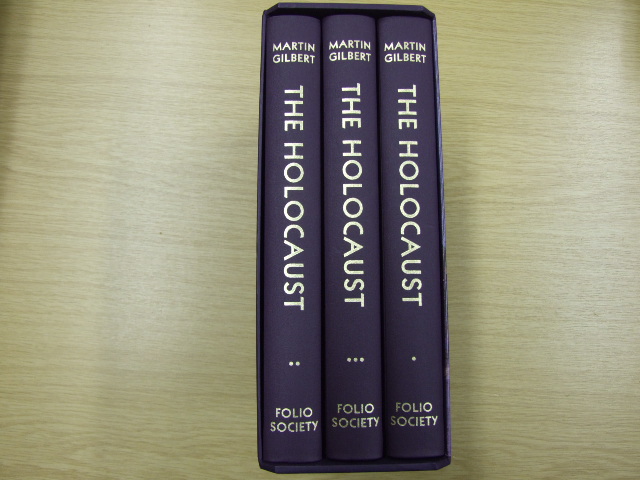

Folio Society Published Works Number 2653
Gilbert, Martin - The Holocaust
We buy and sell items like these, so please contact us if you have similar items for sale, and we will make you an offer if we are interested.
To check if we have this item, or similar items, in stock, please click the Check Stock link below. Alternatively, use the links on the left to search our large online database of items for sale, or to visit the rest of the site.
Check Stock
Gilbert, Martin - The Holocaust (Published in by The Folio Society in 2012. Three volumes. Bound in cloth. Blocked with a design based on the memorial Track 17 at Grunewald station, Berlin. Set in Erhardt. 952 pages in total. 75 pages of colour and black & white plates. Book size: 10" x 6.75". The definitive history, in a new three-volume illustrated edition. Between 1939 and 1945, six million Jewish men, women and children were killed as a consequence of Adolf Hitler's Nazi regime. In a ghastly parody of progress, the apparatus of a modern state – police, railways, the civil service, industrial machinery – was used to carry out mass murder. First published in 1986, The Holocaust is the definitive account of this genocide by one of the foremost world authorities on the Second World War. Martin Gilbert was among the first historians to make full use of the testimonies of Holocaust witnesses, both those who survived and those who died. The result is an unrivalled insight into one of the darkest episodes of human history. Amid the horror, Gilbert pays tribute to the brave actions of communities and individuals. There was the Chief Rabbi of Norway, who chose to be arrested with his community rather than hide; the French General de St-Vincent, who refused to co-operate with the arrests of Jews; Matilda Bandet, who stayed with her elderly parents in Cracow rather than escape, and died with them. He also describes the Jewish partisan units and soldiers, the attempted uprising by the female prisoners at Birkenau and the successful escape of 300 men from Sobibor. One of them, Semyon Rozenfeld, joined the Red Army and was in Berlin on the day of victory. Yet, as Gilbert puts it, to die with dignity was itself courageous, and 'simply to survive was a victory of the human spirit'. )