
Folio Society Published Works Number 2669
Junger, Ernst - Storm of Steel
We buy and sell items like these, so please contact us if you have similar items for sale, and we will make you an offer if we are interested.
To check if we have this item, or similar items, in stock, please click the Check Stock link below. Alternatively, use the links on the left to search our large online database of items for sale, or to visit the rest of the site.
Check Stock
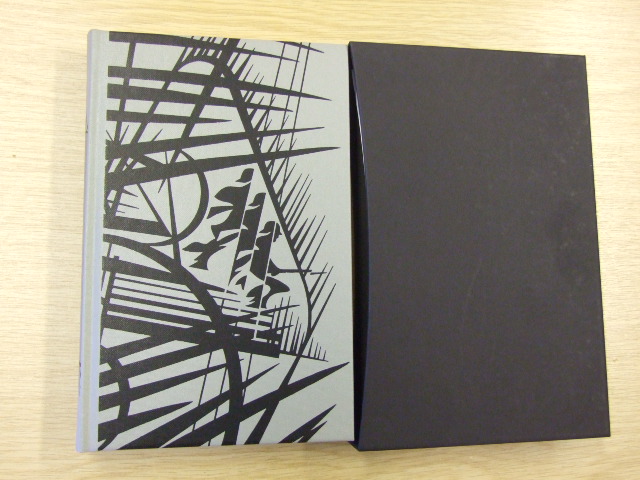
Junger, Ernst - Storm of Steel (Published in by The Folio Society in 2012. Introduced by Richard Vinen. Illustrated by Neil Gower. Bound in buckram, blocked with a design by Neil Gower. Set in Sabon. 296 pages. Frontispiece and 7 colour illustrations. Book size: 9" × 5.75". A simple, chilling and at times deeply moving story of one man's journey through the brutality of war. In this personal memoir Ernst Junger shows us the often macabre realities of his life on the Western Front, an account that is beautiful, powerful and unashamedly honest. Historian Richard Vinen has provided a new introduction and Neil Gower has created new illustrations using sepia tones to compliment Junger's writing. Private Jünger joined up in August 1914, the day war was declared. He arrived by train in Champagne to hear 'the slow grinding pulse of the front'. He fought through almost the whole of the war, but was permanently invalided back to Germany in 1918, having experienced active service in the Somme, Ypres, Arras and the German Spring offensive. Just two years after the war was ended – long before the memoirs of Englishmen like Siegfried Sassoon or Robert Graves – Junger published his extraordinary, raw account: Storm of Steel. He comments with a desensitised, almost laconic voice on the horrors he encountered; he maintains an impersonal respect for the enemy, remarking quietly on their courage. Men die from rifle fire, shell attacks, gas corrupting their lungs; it is casual slaughter and before long, Junger is more concerned over having a nap than the fact that his servant's blood stains the walls of his dugout. His detachment conveys the horror of war with chilling immediacy, from rats eating corpses in cellars to the 'emotional cold' that causes teeth to chatter as the soldier crawls into no-man's-land, 'like having a feeble electric current applied to you'. Ground down by the tedium of trench warfare, Jünger is reminded of home or nature by the merest details of his surroundings. In the same way, his deliberately impassive prose occasionally blooms into the poetic. Going into action in the Somme, Jünger writes, 'We marched as on the gleaming paths of a midnight cemetery.' )