Folio Society Published Works Number 2803
Luo Guanzhong - Three Kingdoms
We buy and sell items like these, so please contact us if you have similar items for sale, and we will make you an offer if we are interested.
To check if we have this item, or similar items, in stock, please click the Check Stock link below. Alternatively, use the links on the left to search our large online database of items for sale, or to visit the rest of the site.
Check Stock
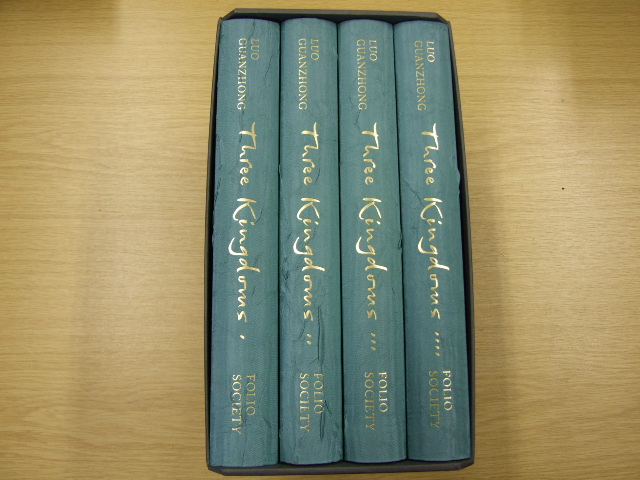
Luo Guanzhong - Three Kingdoms (Published in by The Folio Society in 2013. Introduced by Ma Jian. Translated by Moss Roberts. Bound in vendome cloth. Blocked with images from an 1883 edition of the novel, redrawn by Neil Gower. Set in Swift. 1,664 pages in total with 280 black and white illustrations. Book size: 11" x 7.25". In Chinese culture, the era of the Three Kingdoms (AD 168–280) has achieved the status of legend. Retold in novels, celebrated in operas and echoed in modern media, from television to video games, it permeates Chinese consciousness like no other. It was an era of chaos, of conflicts so bloody that the country's population fell by almost 50 million. But it was also a time of ideological change, with the rise of Buddhist ideals and Taoist principles that rejected the tumult and violence of the warring dynasties. And it produced the country's first professional painters, such as Cao Buxing, often called 'the father of Buddhist painting'. It is from this rich strand of history that Luo Guanzhong's Three Kingdoms emerged. Written in the 14th century, this remarkable novel is one of the great classics of Chinese literature. It is among the most beloved works of literature in East Asia, with an influence in China comparable to that of Shakespeare in the British Isles. While attributed to Guanzhong, it is as much the product of 11 centuries of oral tradition as the fruit of one author's labour, encompassing and cementing the quasi-mythical status of the era. Introducing this edition, Chinese author-in-exile Ma Jian describes Three Kingdoms as 70 per cent history and 30 per cent fiction. The only English language illustrated edition in print. This edition features 280 integrated woodcuts from a 19th-century edition, sourced with the kind assistance of Frances Wood, Curator of Chinese Collections at the British Library. They were probably created in the workshops that thrived throughout the Qing dynasty (1644 to 1911), when the visual arts were prized as a means of reaffirming social values. There are 240 dramatic scenes and 40 character portraits. The books are bound in shimmering cloth, blocked with four key figures redrawn by Neil Gower: Liu Bei (Xuande), Lady Mi, Zuo Ci and Deng Ai. Lady Sun, the daughter of a warlord and third wife of Liu Bei, appears on the slipcase. )