
Folio Society Published Works Number 2808
Runciman, Steven - The Fall of Constantinople 1453
We buy and sell items like these, so please contact us if you have similar items for sale, and we will make you an offer if we are interested.
To check if we have this item, or similar items, in stock, please click the Check Stock link below. Alternatively, use the links on the left to search our large online database of items for sale, or to visit the rest of the site.
Check Stock
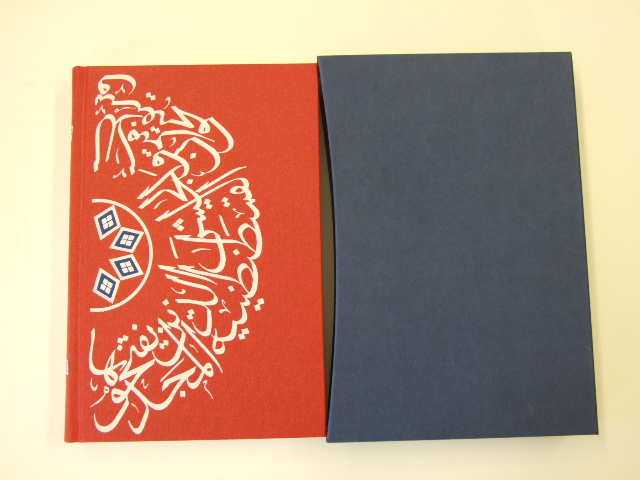
Runciman, Steven - The Fall of Constantinople 1453 (Published in by The Folio Society in 2013. Introduced by Judith Herrin. Bound in buckram. Blocked with Arabic calligraphy. Set in Minion. 256 pages. Frontispiece and 16 pages of colour plates. Book size: 9.5" x 6.25". When the Ottomans captured Constantinople, they established an empire that would last for five centuries. For the Greeks, it brought the end of the Byzantine civilisation. Steven Runciman's account of the fall remains a classic, informing historians and enthralling a wide range of readers with its gripping narrative. Runciman begins with the events leading up to the siege of the 'Queen City' – the alliances made and broken, the triumphs and defeats, the rise of the Sultanate and the decisive cry of the young Sultan Mehmet II: 'Give me Constantinople'. We see his army advance by land and sea, armed with 'new-fangled machines', and learn of the crucial role played by the enterprising Hungarian cannon-maker, Urban. Runciman conveys the simultaneous courage and despair of the citizens as they eyed the approaching fleet, their pleas for help from Italy's reluctant politicians and the fearless responses of individuals such as Giovanni Giustiniani Longo, who arrived from Genoa with several hundred soldiers, eager to join the defence. The chapter on the siege itself is so vivid that it reads as a thrilling minute-by-minute account. Throughout, Runciman effortlessly combines the historian's sweeping view with the great writer's insight into the experiences of people on both sides, from the cardinal who escaped the falling city by exchanging clothes with a beggar, to the unhappy fate of the brave Turkish admiral, Baltoghlu. Judith Herrin, Emeritus Professor of Late Antique and Byzantine Studies at King's College London, praises this quality in her introduction, describing as Runciman's hallmark 'his deep affection for the individual players in historical events'. This is the first illustrated edition of The Fall of Constantinople 1453, which was originally published in 1965. It features maps as endpapers and 20 full-colour images taken from manuscripts, illuminations, paintings and artefacts. Josh Berer, a calligrapher and designer, has created an elegant binding based on a Hadith. )