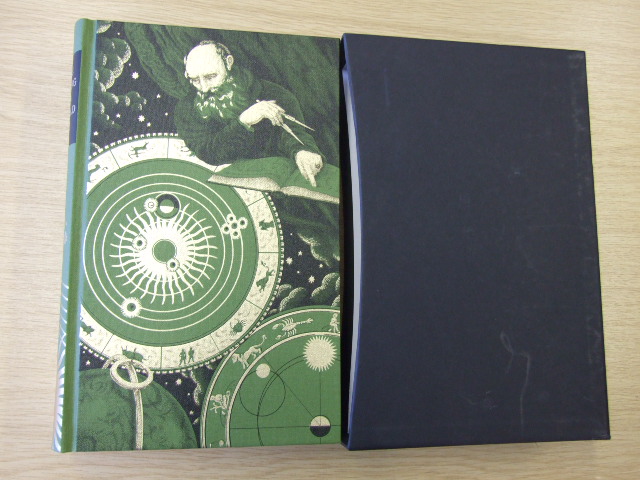

Folio Society Published Works Number 2825
Galileo Galilei - Dialogue Concerning the Two Chief World Systems
We buy and sell items like these, so please contact us if you have similar items for sale, and we will make you an offer if we are interested.
To check if we have this item, or similar items, in stock, please click the Check Stock link below. Alternatively, use the links on the left to search our large online database of items for sale, or to visit the rest of the site.
Check Stock
Galileo Galilei - Dialogue Concerning the Two Chief World Systems (Published in by The Folio Society in 2013. Bound in buckram. Printed and blocked with a design by Neil Gower. Set in Adobe Garamond Pro. 600 pages. Frontispiece and 32 pages of colour plates. Book size: 10" x 6.25". A fascinating insight into Galileo's fundamental contribution to science. Introduced by the Pulitzer Prize finalist writer Dava Sobel. When Galileo completed the first great work of modern science in 1632, he paved the way for freedom of scientific thought and paid the price with the loss of his own liberty. Supporting Copernicus's heliocentric view of the universe against Ptolemaic geocentrism, the Dialogue was condemned by the Catholic Church, making Galileo a prisoner of the Inquisition for the rest of his life. Nevertheless it began a revolution, undermining the classical, reason-based tradition endorsed by the Church – because it supported the notion that humankind, and therefore God, lay at the centre of the universe – and leading science back to an objective, empirical attitude towards the cosmos. Partly in an attempt to satisfy the Church, which had granted him permission to explain but not to endorse Copernicus's theory, Galileo presented his ideas as a lively debate between two men, overseen by a neutral commentator, Sagredo. But by naming the defender of God's intelligent design Simplicio (simpleton) and clearly aligning himself with Salviati, the proponent of the sun-centred view, Galileo displayed his beliefs all too clearly. What's more, the Dialogue was considered particularly dangerous because, unlike Copernicus's earlier work, it was aimed not at scholars but ordinary people. Galileo wrote in Italian, rather than Latin, and the book has the feel of a four-act play, with Simplicio and Salviati coming and going by gondola from Sagredo's palazzo on Venice's Grand Canal. Dramatic tension, poetic devices and humour are plentiful. Indeed it is Galileo's brilliance as a prose stylist, as well as his seminal contribution to modern science, that makes the Dialogue so appealing to today's reader. Dava Sobel, an award-winning science writer whose books include Longitude and the Pulitzer Prize finalistGalileo's Daughter, has written a new introduction. She notes that the first edition of the Dialogue 'doubled in price on the black market, was smuggled out of the country, translated into Latin, into English, into German' and considers why this bold work still has the power to fascinate. The text follows the definitive 1953 University of California Press edition, translated by Stillman Drake. It is illuminated by a wonderful selection of cosmographical illustrations, taken from European texts from the 9th century through to Galileo's day. Alongside them are Galileo's own drawings of his observations, including the phases of Venus, sunspots and the satellites of Jupiter. )