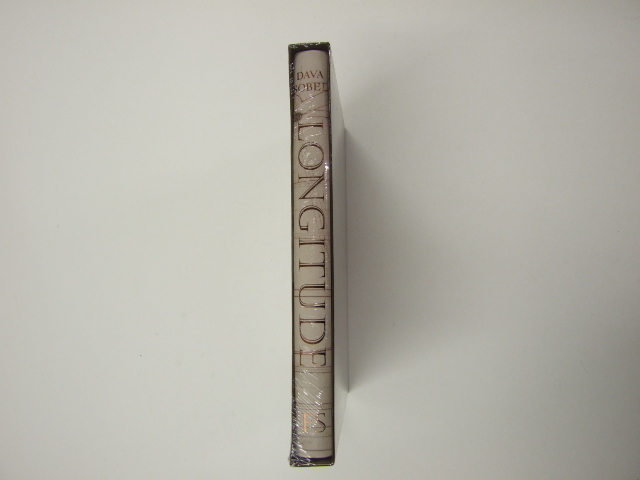

Folio Society Published Works Number 3024
Sobel, Dava - Longitude
We buy and sell items like these, so please contact us if you have similar items for sale, and we will make you an offer if we are interested.
To check if we have this item, or similar items, in stock, please click the Check Stock link below. Alternatively, use the links on the left to search our large online database of items for sale, or to visit the rest of the site.
Check Stock
Sobel, Dava - Longitude (Published in by The Folio Society in 2014. A fascinating story of perilous seas and brilliant innovation, accompanied by wonderful colour photographs. Dava Sobel's acclaimed history of how John Harrison took on the scientific establishment to solve the most pressing problem of his era inspired an entire genre of popular history writing, and brought deserved attention to one of the unsung heroes of science. For although Harrison received his prize money, at the insistence of King George III, it had taken him 40 years of unremitting toil, and numerous trials, controversies and arguments. The crowning injury was that his beloved chronometers were stored away and forgotten, while others manufactured affordable copies. In her new preface, Sobel mentions the beauty of the originals that 'has ever won admiration from artists and scientists alike'. It is their beauty that this new edition from The Folio Society emphasises, with glorious colour photographs and Harrison's original pen-and-ink drawings showing the clocks' intricate mechanisms and exquisite decoration. Bound in paper, printed with a drawing of the rear part of H-3 by John Harrison. Set in Baskerville with Bodoni display. 168 pages; frontispiece and 16 pages of colour plates. Printed endpapers. 9" x 6.25". A matter of life and death. Throughout the great age of exploration, every sailor was quite literally lost at sea. Columbus could 'sail the parallel', that is, follow a line of latitude across the ocean until he bumped into the Americas. Yet he, and all other sailors, were unable to determine their longitude and thus chart their position. Navigational errors hugely increased the risk of shipwreck and long voyages, and for burgeoning trading empires solving the problem was not only worth a fortune, but a matter of life and death. It was therefore crucial that in 1714 – exactly 300 years ago – the Longitude Act was established promising a prize of £20,000 to whoever could find a practicable solution. It was a huge sum of money and world-renowned inventors and scientists scrambled to compete for it. But the prize was eventually won, not by an astronomer royal, but by an uneducated carpenter, John Harrison, who devoted his life to creating a marine chronometer that would keep time at sea. Click here to read a blog post by Picture Editor Laura Canter on John Harrison's 'fantastical machines'. Powerful enemies and would-be thieves. Throughout their embattled lives, the timekeepers that John Harrison built to solve the Longitude Problem have called attention to themselves as singular creations. They are engineering marvels, designed and fashioned in the eighteenth century with scant regard for the conventional wisdom of contemporary clockmakers. Although their beauty has ever won admiration from artists and scientists alike, Harrison's sea-going clocks faced a series of powerful enemies. . . Sir Isaac Newton, one of the commissioners impaneled in 1714 to judge the £20,000 Longitude Prize competition, doubted the very notion of a timekeeper solution to the Problem. Harrison proceeded on that course nevertheless. He braved a sickening ocean voyage to demonstrate the validity of his ideas, and later dispatched his only living son on two transatlantic trials required by the Board of Longitude. Harrison also fended off rivals trying to steal his inventions, felt the wrath of the astronomer royal, and waged a lengthy struggle with Parliament to claim his due. . An extract from Dava Sobel's introduction. From the Folio Society description. )