
Folio Society Published Works Number 3029
Kierkegaard, Søren - Fear and Trembling
We buy and sell items like these, so please contact us if you have similar items for sale, and we will make you an offer if we are interested.
To check if we have this item, or similar items, in stock, please click the Check Stock link below. Alternatively, use the links on the left to search our large online database of items for sale, or to visit the rest of the site.
Check Stock
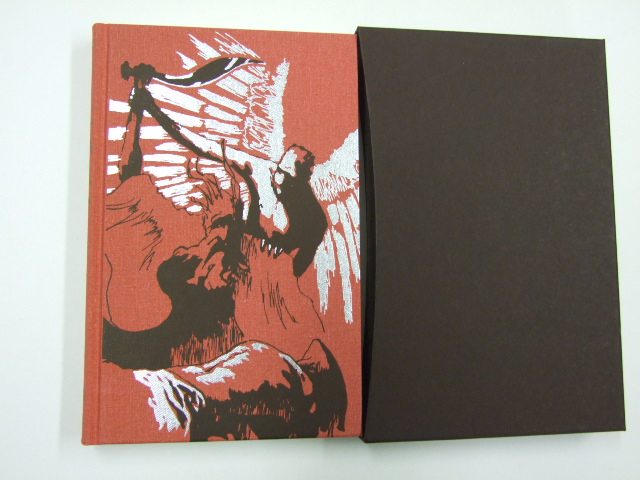
Kierkegaard, Søren - Fear and Trembling (Published in by The Folio Society in 2014. Introduced by Jonathan Ree. Illustrated by Paul Scheruebel. One of the world's great philosophical texts, Kierkegaard's masterpiece is presented in a magnificent new edition. Fear and Trembling. An earnest and yet humorous attempt to elucidate the question of religious faith, Fear and Trembling is one of philosophy's most engaging and unconventional texts. Published in 1843, it centres on the story of Abraham, who agrees to God's request that he sacrifice his only son. At the last moment, God stays his hand: in resigning to God's will, Abraham has amply demonstrated his faith. But what do we make of a creator who sets such a test? Illuminating Kierkegaard's paradox is a series of arresting images by Paul Scheruebel, presenting Abraham's choice from multiple perspectives. Fear and Trembling book. Translated from the Danish by Alastair Hannay. Bound in cloth. Set in Van Dijck with Trajan Pro display. 160 pages. Frontispiece and 6 colour illustrations. Book size: 9" x 5.75". A zealous humorist and a light-hearted fanatic. . An earnest and yet humorous attempt to elucidate the question of religious faith, Fear and Trembling is one of philosophy's most engaging and unconventional texts. In his introduction, philosopher Jonathan Rée describes Kierkegaard as 'a Christian and a scourge of Christianity … a zealous humourist and a light-hearted fanatic', giving us some measure of the author's complex and contradictory character. Raised by a pious father, he for a time pursued the life of a debonair man-about-town, propelled by dreams of becoming a literary star. At university he was struck by what he saw as the dullness of such celebrated thinkers as Descartes and Hegel. On graduating he pursued an ambitious goal: to present anew the problems of theology and thus safeguard religion from the claims of philosophers who, in his view, overstated their grasp of essential truths. 'Read it with an open mind, and watch it waltz off with the pin'. Jonathan Rée. Fear and Trembling was Kierkegaard's third work. Published in 1843, it centres on the story of Abraham, who agrees to God's request that he sacrifice his only son. At the last moment, God stays his hand: in resigning to God's will, Abraham has amply demonstrated his faith. But what do we make of a creator who sets such a test? And in what sense is Abraham to be seen as epitomising faith? Kierkegaard poses as the learned but light-hearted Johannes de Silentio, who first presents four versions of Abraham and Isaac's experience. In the second half, Kierkegaard's dialectical approach reveals his concerns about the limitations of philosophical thought in the face of the ineffable. By questioning received wisdoms, Kierkegaard underlines the paradoxes inherent in the story of Abraham and the model of faith that it represents. Paul Scheruebel's fascinating paintings present Abraham's choice from Kierkegaard's multiple perspectives. Søren Kierkegaard (1813–1855). Søren Kierkegaard (1813–1855) was a Danish writer whose prolific and wide-ranging work crosses the boundaries of philosophy, theology, psychology, literary criticism, aesthetics and fiction. He is best known for the ethical and religious works written between 1843 and 1849, which include Either/Or (1843), Repetition (1843), Fear and Trembling (1843), The Concept of Anxiety (1844), Concluding Unscientific Postscript (1846) and The Sickness unto Death (1849). A number of Kierkegaard's philosophical themes were taken up by a later generation of philosophers, and he is credited with setting the stage for modern existentialism. Paul Scheruebel - illustrating philosophy. Paul Scheruebel studied Illustration at the University of Westminster. He now lives in Switzerland where he is co-founder of the illustration studio Paul Alltag and has participated in exhibitions in Graz, Vienna and London. He paints mainly in oils and draws inspiration from mythology, the Lowbrow Movement and abstract expressionism. 'When I first started thinking about how the images would relate to the text and to each other I thought I would try to show the process of Abraham's letting go of his most treasured worldly possession, so to speak. I thought I would first make the scene very brutal and bleak and then shift the focus from the sacrificed son to the redeeming power of god. In the end everything would be restored in light and glory. Conceptually that would have reflected Kierkegaard's interpretation really well but when I started sketching out the images I found it seemed too calculated, too predictable. Also, each image had to be a strong image in its own right so the series would not be too repetitive. There had to be a reason for readers to be interested in what the next image would be like, so there had to be room for surprise. It became clear that the series would have to be more experimental and more fluid.'. Paul Scheruebel on his paintings for Fear and Trembling. Paul Scheruebel very kindly provided The Folio Society with photographs of his notebooks and studio. Click the images below to see how the paintings for this edition took shape. From the Folio Society description. )