
Folio Society Published Works Number 3031
Stevenson, Robert Louis - Treasure Island illustrated by Sterling Hundley
We buy and sell items like these, so please contact us if you have similar items for sale, and we will make you an offer if we are interested.
To check if we have this item, or similar items, in stock, please click the Check Stock link below. Alternatively, use the links on the left to search our large online database of items for sale, or to visit the rest of the site.
Check Stock
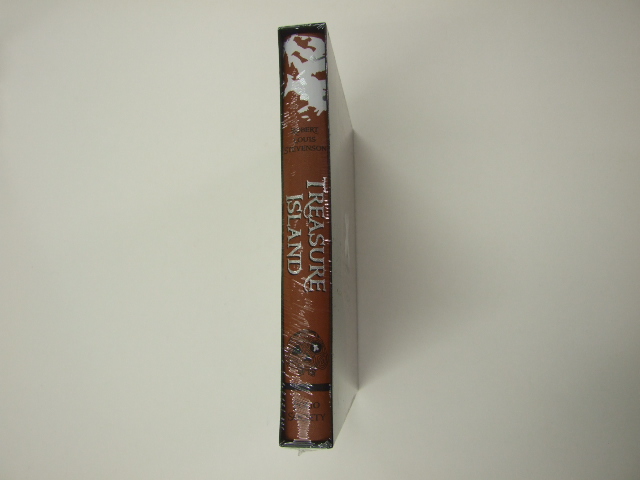
Stevenson, Robert Louis - Treasure Island illustrated by Sterling Hundley (Published in by The Folio Society in 2014. Introduced by Michael Morpurgo. Illustrated by Sterling Hundley. A classic tale of heroism, piracy and adventure that has never been equalled – with an introduction by Michael Morpurgo. Treasure Island. 'I remember him as if it were yesterday, as he came plodding to the inn door, his sea-chest following behind him in a handbarrow.' Young Jim Hawkins is at once terrified and captivated by the rum-soaked sea-dog who takes up lodgings at his father's inn, the Admiral Benbow. But after discovering a treasure map in the sailor's trunk, Jim embarks on a perilous journey of treachery, heroism and piracy aboard the ship Hispaniola. Winner of the Book Illustration award and overall prize at the V&A Illustration Awards 2015. Treasure Island book. Bound in buckram, blocked with a design by Sterling Hundley. Set in Bulmer. 256 pages; frontispiece and 11 colour illustrations and the original Stevenson map. Printed endpapers. Blocked slipcase. 10" x 7.5". A collector's edition of a swashbuckling classic. Sterling Hundley created his compelling illustrations using a combination of pencil drawing, painting and digital techniques. His work is both influenced by and stands out from a long tradition of illustrating this iconic story. As Hundley remarked when accepting the commission: 'Treasure Island is hallowed ground in the world of illustration. I would be honoured to take on the project.'. In 1882, the year before Treasure Island was published, Stevenson lamented that romantic tales had become eclipsed by realism: 'English people of the present day are apt, I know not why, to look somewhat down on incident … It is thought clever to write a novel with no story at all, or at least with a very dull one.' His answer was to write an adventure story that would become ubiquitous, a novel that would not only set a course for future children's literature, but also conjure characters, motifs and language that would become part of our collective imagination. Indeed, a pirate without a buried treasure and a wooden leg, a talking parrot and 'pieces of eight', is no pirate at all. Nurtured by Stevenson's rebellious nature, the text is informed by an air of moral ambiguity – an air that becomes manifest in the seductive charm of Long John Silver. As Michael Morpurgo writes in his new introduction, 'Like Jim, we are at first entertained and entranced by Silver, then appalled and entranced again.' Silver's moral pragmatism flew in the face of the stale fiction for boys that preceded Stevenson's landmark work. The text's darkling nature is captured in Sterling Hundley's enthralling illustrations, which convey both the vivid excitement of Jim's travels and the claustrophobic terror he feels as the journey begins to go awry. Also included is the treasure map drawn by Stevenson. Rarely printed in colour, the different inks represent various characters' annotations. The blocked, skull-emblazoned slipcase is a reminder of the pirates' treachery, the Jolly Roger and the chilling refrain, 'Fifteen men on the dead man's chest / Yo-ho-ho, and a bottle of rum!'. Click here to read a blog post by the illustrator, Sterling Hundley. An adventure both incredible and believable. With a deft dab of description, with a turn of phrase or a tone of voice, Robert Louis Stevenson brings everyone in Treasure Island to life: Jim Hawkins, Long John Silver, Dr Livesey, Ben Gunn and the rest. Each and every one is both plausible and complex. Through Jim's wide eyes—I was Jim when I first read this book, saw all of it, lived it, through him—we see the Jekyll and Hyde in Long John Silver. Like Jim, we are at first entertained and entranced by Silver, then appalled and entranced again. The thread of the story is seamless because no one is pulling the strings except the characters themselves; the author just goes along with them, or so it seems. It takes life so convincingly. We believe at once in poor Ben Gunn, live with Jim as he overhears murderous conspiracy while hidden in the barrel of apples on board the Hispaniola, and as he endures danger and fear with his friends behind the stockade on Treasure Island. As for place, I know the Admiral Benbow inn, where the book begins, as well as I do my own village pub. I can picture every nook and cranny of it. I know the Hispaniolaem. As well as if I'd sailed on her—from the exact location of the barrel of apples in which Jim hides, to how the sails are set and how the lantern swings below in the cabin, how she creaks and groans at sea or riding at anchor. And Treasure Island I know like I know the island of Bryher in the Isles of Scilly, where I've spent my summer holidays for over thirty years. (I'm sure Treasure Island is why I go there.) Jim Hawkins has taken me to Treasure Island and shown me the lie of the land, the marshy groves, the stockade on the hill. I know the entire coastline as Jim takes the helm of the Hispaniola, and single-handedly sails the ship. All utterly incredible, but made credible. An extract from Michael Morpurgo's introduction. From the Folio Society description. )