
Folio Society Published Works Number 3041
William of Malmesbury - The Deeds of the English Kings
We buy and sell items like these, so please contact us if you have similar items for sale, and we will make you an offer if we are interested.
To check if we have this item, or similar items, in stock, please click the Check Stock link below. Alternatively, use the links on the left to search our large online database of items for sale, or to visit the rest of the site.
Check Stock
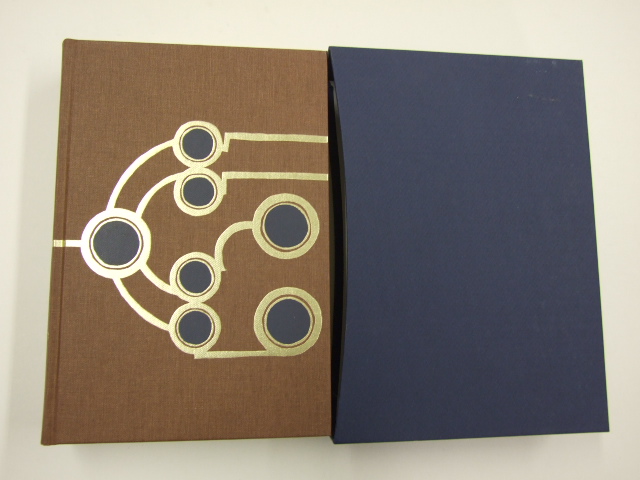
William of Malmesbury - The Deeds of the English Kings (Published in by The Folio Society in 2014. Introduced by Peter Ackroyd. Malmesbury's fascinating, ebullient history is presented anew in a beautifully designed edition featuring full-page illuminations. The Deeds of the English Kings. In the early 12th century, with encouragement from Queen Matilda, William, the librarian of Malmesbury Abbey, began to write a history of the English kings. Born to a Norman father and an English mother at a time when the Norman Conquest was a fresh memory, William had a unique perspective on English history. His work was an ambitious one, stretching from the first arrival of Saxon invaders right up to his own time, and involving extensive first-hand research. It was daring too, since William did not hesitate to include some trenchant criticisms of the Norman kings. Production Details. The Deeds of the English Kings book. Bound in cloth, blocked with artwork by Charlotte Orr. Translated by R. A. B. Mynors. Set in Minion with Givry and Clairvaux display. 608 pages; frontispiece and 24 pages of colour plates. Gilded top edge. 10" x 6.75". A glorious edition for enthusiasts of English history. In his ardent introduction to our edition, Peter Ackroyd asserts that the author should share with Bede the title of 'father of English history'. As Ackroyd points out, William was a great historian because he was a great writer – one who believed that history should be written with 'a competence and splendour that would engage the spirit as well as arouse the mind'. In this lively translation, his voice comes to us clearly from across the centuries: 'I began to get the itch to write myself, not to show off my more or less nonexistent erudition but in order to bring forcibly into the light things lost in the rubbish-heap of the past.' Whether he is outraged by Osred, who led a 'shameful existence in the ravishing of nuns', or delighted by Earconberht because he forced Lent on a people who were 'simply the slaves of their own stomachs', William is always entertaining. This glorious Folio edition will bring pleasure to anyone with a love of English history and fine writing – his work deserves a much wider audience. In addition it contains full-page illuminations depicting dramatic moments from the Deeds, all sourced from medieval manuscripts. After studying an original manuscript written and signed by William himself, our design team was inspired to give our edition a particularly special treatment. Initial letters have been hand-drawn by the calligrapher Charlotte Orr, each one unique. Display fonts and chapter headings are picked out in rubric, while even the deep lower margin is a reflection of the original layout's 'golden rectangle' design. The edition also features gilded top page edges. The result is an entirely modern response to the idiosyncratic beauty of medieval manuscripts Malmesbury – the complete historian. His reputation as an historian survived the succeeding centuries, and he was praised in the seventeenth century by John Milton as 'by far the best of all' the twelfth-century chroniclers in terms of both 'style and judgement'. Milton's own History of Britain owes much to William both as example and as inspiration. He was admired in the nineteenth century by scholars such as M. R. James, and so great is his influence that many of the events and details of his Gesta regum are still repeated by contemporary historians. . . So in all the most important respects he was the complete historian; he was not unduly biased, and his narrative is a faithful attempt by him to convey all that he heard and read. If there have been greater historians in England, it is hard to think of one who was more sedulous and conscientious. He must share with his great predecessor, Bede, the title of father of English history. . An extract from Peter Ackroyd's introduction )