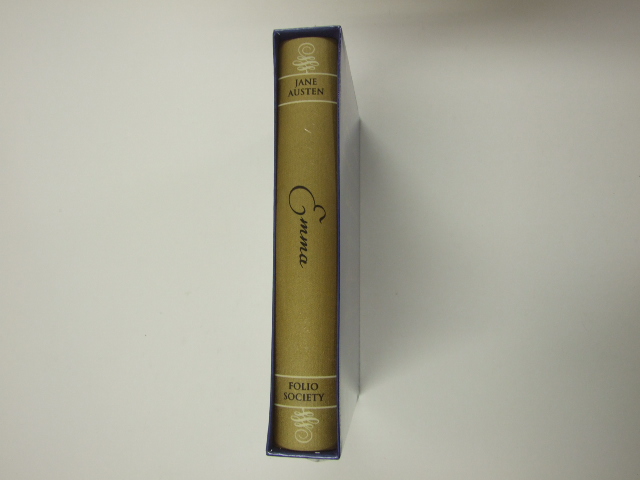

Folio Society Published Works Number 3052
Austen, Jane - Emma Revised Edition
We buy and sell items like these, so please contact us if you have similar items for sale, and we will make you an offer if we are interested.
To check if we have this item, or similar items, in stock, please click the Check Stock link below. Alternatively, use the links on the left to search our large online database of items for sale, or to visit the rest of the site.
Check Stock
Austen, Jane - Emma Revised Edition (Published in by The Folio Society in 2015. Introduced by Fay Weldon. Illustrated by Sam Wolfe Connelly. Published in series with Pride and Prejudice, this sparkling edition is introduced by Fay Weldon. 'I am going to take a heroine whom nobody but myself will much like,' wrote Jane Austen when beginning Emma in January 1814. In this she was proved wrong. Pride and Prejudice may be her most famous novel, Persuasion her most deeply affecting, but for many, Emma is Austen's best novel; the most perfectly balanced between comedy and insight, sparkle and depth. Witty, headstrong Emma Woodhouse, more interested in making matches for others than falling in love herself, is a wholly delightful heroine. The secondary characters – the impressionable Harriet, egotistical Mr Elton and Emma's gentle, hypochondriac father – are just as unforgettable. 'A mature and brilliant comedy of manners'. ROBERT MCCRUM, Observer. Emma book. Bound in metallic cloth, blocked with a design by Sam Wolfe Connelly. Set in Baskerville with Trajan display. 448 pages. Frontispiece and 9 colour illustrations. Blocked slipcase. 9.5" x 6.25". A novel '50 years' ahead of its time. Appearing in 1815, Emma was Jane Austen's fourth published novel, written in a burst of confidence following the success of Sense and Sensibility and Pride and Prejudice. This Folio edition, published to celebrate the novel's bicentenary, features a new introduction by Fay Weldon, whose Letters to Alice: On First Reading Jane Austen's Fiction has become a classic introduction to Austen's works. In it, Weldon describes how 'a hint of success and a whiff of praise' may have helped bring Austen to the peak of her powers as an artist. 'In pleasing herself she wrote a truly modern novel fifty years in advance of its time, in which the writer acts, feels and thinks like her protagonist, and the disbelief of the reader is happily suspended.' Sam Wolfe Connelly is a young American artist who previously illustrated the Folio edition of The Great Gatsby. In his illustrations, he captures the grace and elegance of the period, and the way in which the smallest gestures could have the greatest significance. This edition is presented in a metallic blue slipcase, with the novel's famous first line blocked in gold type on the front cover. An extract from Fay Weldon's introduction. Jane Austen wrote Emma while she was living with her mother, her sister Cassandra and their friend Martha Lloyd in Chawton, a small Hampshire village on the coach road to London, some fifty miles away from the capital. The year was 1815. The four women lived frugally but com- fortably enough, with a cook, two maids and an outside man to do the heavy work. It was here in a small room – one of its windows blocked up to stop passers-by staring in – on a small walnut table, and using a quill pen, that Austen wrote three novels in as many years: Mansfield Park in 1814, Emma in 1815, and Persuasion in 1816. . . She covered page after page in a well-spaced, confident hand with abundant blots and crossings-out as she rephrased sentences or refined her ideas. . . She would have thought before she wrote, not having the advantage that contemporary novelists have in the form of the computer, the spell check and the delete key, all of which make second thoughts so easy – perhaps too easy. The novels brought her little personal fame (like all her works they were published anonymously, attributed only to 'A Lady') and less fortune. On this small walnut table, seized by inspiration and expectation, she wrote the famous opening of Emma: 'Emma Woodhouse, handsome, clever, and rich, with a comfortable home and happy disposition, seemed to unite some of the best blessings of existence; and had lived nearly twenty-one years in the world with very little to distress or vex her.' It is claimed by many as the best first sentence of a novel ever, setting as it does (if one is to adopt the language of the creative-writing class) tone, style, voice and point of view. Why would anyone not want to read on?. Jane Austen was born in Hampshire in 1775, the seventh child and youngest daughter of George Austen, rector of Deane and Steventon, and his wife, Cassandra. She began writing poems, plays and stories for her family from a young age, and her first published novel, Sense and Sensibility, was released by Thomas Egerton to sell-out acclaim in 1811. Pride and Prejudice (1813) and Mansfield Park (1814) swiftly followed, and in 1815 Austen moved to the London publisher John Murray for the publication of Emma, the last of Austen's works to come out in her lifetime. Her novels, including the posthumously published Northanger Abbey (1818) and Persuasion (1818), are today considered amongst the finest in the English language. She died at Winchester in 1817. From the Folio Society description. )