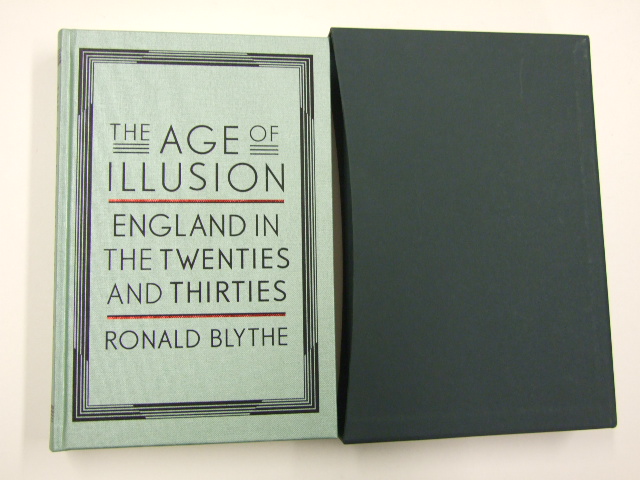

Folio Society Published Works Number 3207
Blythe, Ronald - The Age of Illusion
We buy and sell items like these, so please contact us if you have similar items for sale, and we will make you an offer if we are interested.
To check if we have this item, or similar items, in stock, please click the Check Stock link below. Alternatively, use the links on the left to search our large online database of items for sale, or to visit the rest of the site.
Check Stock
Blythe, Ronald - The Age of Illusion (Published in by The Folio Society in 2015. Bound in metallic buckram, blocked with a design by Raquel Leis Allion. Set in Perpetua. 368 pages; frontispiece and 16 pages of black & white plates. Printed endpapers. 9.5" × 6.25". Introduced by Dominic Sandbrook. Britain between the wars is brilliantly and entertainingly chronicled in this book by the author of Akenfield. Before publishing Akenfield, his famous portrait of a Suffolk village, Ronald Blythe wrote The Age of Illusion. More than a social history, it is a brilliant study of Britain between the wars. Focusing on notable people and events, it takes the reader on an insightful and urbane tour of two decades, from the early days of the BBC, cocktails and the Charleston to the International Brigade and the downfall of Neville Chamberlain. Blythe has a novelist's eye for detail and an inimitable turn of phrase, whether he is describing the Munich Conference ('a dark deed done in the limelight') or Edward VIII ('a small fair man in very loud tweeds'). We learn that among the arguments against Edward's abdication was the consideration that 'a Yorkshire pottery firm would have at least a quarter of a million mugs left on its hands if he left the Throne now'. As well as astute analyses of socialism and the Jarrow Marchers, there are lively accounts of now-forgotten sensations, such as the Brighton Trunk Murders and the trial of Reverend Harold Davidson, notorious for his affairs with young women. In a specially commissioned introduction, historian Dominic Sandbrook pays tribute to Blythe's 'wit, his passion, his underlying sense of right and wrong' and explains why he considers this to be the best history of the period. Photographic highlights include a party at the Silver Slipper club for owner Kate Meyrick, the nightclub queen of London, Basque refugee children arriving in Britain, and an unusual portrait of T. E. Lawrence. Endpapers show photographs of two newspaper-sellers, one heralding the end of the First World War and the other announcing the beginning of the Second. )